The Mendelow stakeholder matrix, sometimes called the Mendelow model or the Mendelow grid, is one of the most widely used tools for stakeholder mapping in project, programme and procurement management. By plotting each stakeholder’s power to influence a project against their level of interest in it, the matrix helps you decide where to focus your time, communication and resources, and where not to.
What Is the Mendelow Stakeholder Matrix?
Developed by Aubrey Mendelow in 1991, the Mendelow model gives project teams a simple, repeatable way to map stakeholder influence. Rather than treating every stakeholder the same, it separates them along two dimensions, how much power they hold over the project’s outcome, and how much interest they have in it, so engagement effort is spent where it matters most.
What Does the Mendelow Grid Look Like?
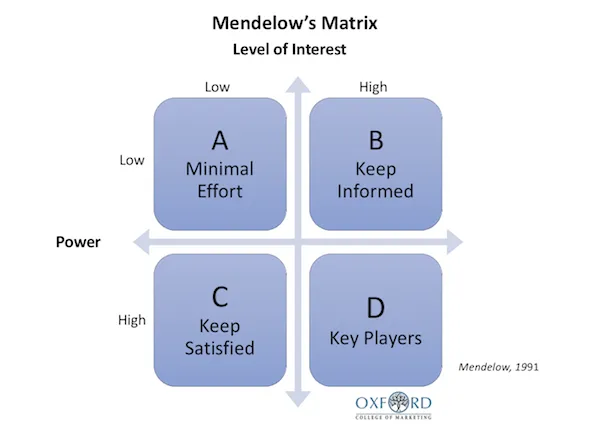
The Mendelow grid is a 2×2 matrix with Power running along one axis and Interest along the other, creating four quadrants:
- High power, high interest: Manage Closely: your key players, engage them fully and regularly.
- High power, low interest: Keep Satisfied: enough information to keep them on side, without overwhelming them.
- Low power, high interest: Keep Informed: regular updates, since they can influence opinion even without formal authority.
- Low power, low interest: Monitor: minimal effort, watch for any shift into another quadrant.
Where a stakeholder sits on this grid determines the communication and engagement plan you build for them in the five steps below.
Who Should Use the Mendelow Stakeholder Matrix?
The matrix is used by project and programme managers, procurement and supply chain professionals managing multi-party contracts, and anyone responsible for bringing a diverse group of stakeholders — internal teams, suppliers, regulators, communities — onto the same page. It’s a recurring topic across procurement, supply chain and project management qualifications, including CIPS, because stakeholder mapping underpins almost every large procurement or project decision.
Mendelow’s Stakeholder Mapping Process: 5 Steps
Identify Stakeholders
List everyone the project affects or who can affect it, internal departments, suppliers, customers, regulators, and community groups, so no one is overlooked before planning begins.
Assess Power and Interest
Rate each stakeholder on their ability to influence outcomes and how concerned they are with the result, so you can prioritise effort honestly rather than by assumption.
Segment Stakeholders
Place each stakeholder into one of the four Mendelow grid quadrants above, based on the ratings from step two.
Tailor Communication
Build a distinct communication plan for each quadrant, so a Manage Closely stakeholder gets regular direct engagement while a Monitor stakeholder isn’t over-communicated to.
Continuous Monitoring
Stakeholder power and interest shift as a project progresses, revisit the matrix at key milestones so your engagement plan stays accurate rather than fixed at kickoff.
A Worked Example
Picture a public infrastructure project. The funding body has high power and high interest, so it sits in Manage Closely and gets weekly updates. A regulatory authority has high power but lower day-to-day interest, so it moves into Keep Satisfied with periodic compliance reports. A local community group has high interest but little formal power, placing it in Keep Informed through regular, plain-language updates. A minor equipment supplier, with low power and low interest in the wider project, sits in Monitor and needs only standard contract communication. Mapping all four this way, rather than treating them identically, is the entire value of the exercise.
Benefits of Using the Mendelow Matrix
Done properly, Mendelow’s stakeholder mapping gives a project team: clearer prioritisation of where engagement time actually goes; early visibility of stakeholders who could block or delay a project if under-engaged; a shared, visual reference the whole team can work from instead of relying on individual judgement; and a lower risk of stakeholder conflict late in a project, because expectations were managed from the start.
Used consistently, not just once at project kickoff, the Mendelow stakeholder matrix turns stakeholder management from a vague best-practice sentiment into a working tool you can actually apply, review and defend.